New London County Dog Registration Information
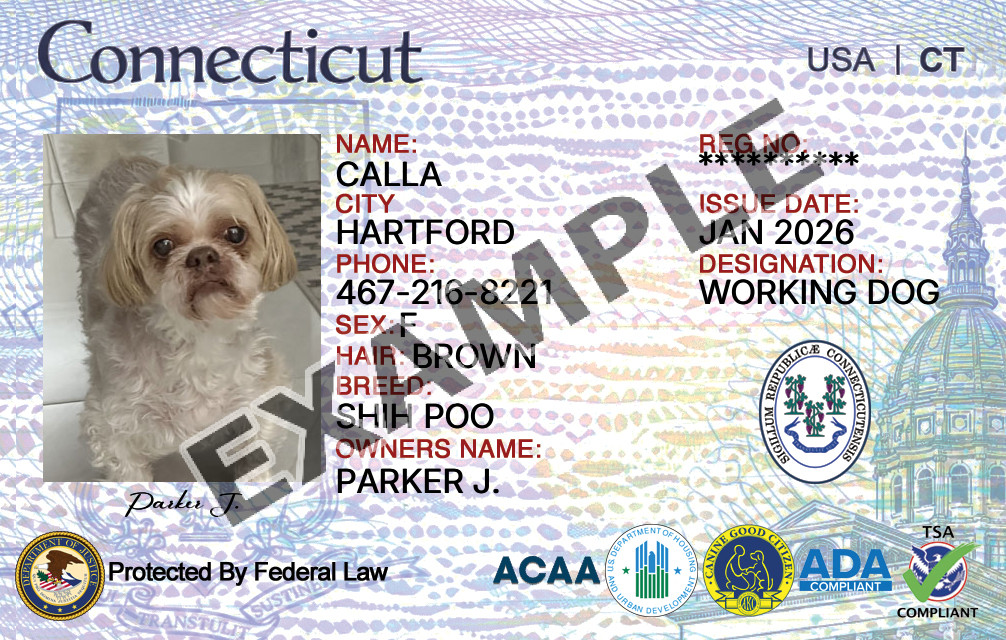
Service Dogs and Emotional Support Animals in New London, Connecticut
If you’re asking, “where do I register my dog in New London County, Connecticut for my service dog or emotional support dog?” the key point is that dog “registration” in Connecticut is typically handled as a local dog license issued by the city or town where you live. New London County does not operate a single countywide dog registry for residents; instead, each municipality (city/town) manages dog licensing through its clerk’s office (and animal control may enforce licensing and vaccination rules).
- There is no single universal federal government registry to “register” a service dog or an emotional support animal.
- You may still need a local dog license in New London County, Connecticut even if your dog is a service dog or an ESA.
- Local licensing commonly requires proof of current rabies vaccination and basic owner/dog details.
Where to Register or License Your Dog in New London County, Connecticut
Start with the clerk’s office for your municipality (City Clerk or Town Clerk). Below are verified official offices serving residents in multiple New London County municipalities. If you do not see your town listed, contact your local Town/City Clerk or local animal control for the correct licensing office for your address.
City of New London — City Clerk (City Hall)
City of Norwich — City Clerk (Norwich City Hall)
Town of Groton — Town Clerk (Town Hall)
City of Groton — City Clerk (Municipal Building)
Town of Stonington — Town Clerk
Town of North Stonington — Town Clerk (Town Hall)
Overview of Dog Licensing in New London County, Connecticut
How licensing works (county context)
In New London County, dog licensing is generally administered at the municipal level (your city or town). That means the right answer to “where to register a dog in New London County, Connecticut” is usually: the Town Clerk or City Clerk in the municipality where the dog lives.
Why municipalities handle dog licenses
Local licensing supports several practical public-safety and administrative needs, including:
- Connecting a dog to an owner for identification purposes
- Supporting rabies control and proof-of-vaccination requirements
- Helping animal control return lost dogs more quickly
- Ensuring a consistent process for renewals, fees, and local records
Local variation within New London County
Requirements can differ slightly by city/town (for example: renewal timing, accepted payment methods, whether mail-in is allowed, and whether a separate tag is issued). If you recently moved within New London County, be sure you are licensing your dog in the current municipality of residence, not a former address.
What You Need Before Registering a Dog
Common documents and details
While each municipality can set its own process, dog licensing requirements in New London County, Connecticut commonly include:
- Rabies vaccination certificate showing current vaccination status (often required for initial license and renewals)
- Owner identification (photo ID may be needed for some clerk transactions)
- Proof of residency in the city/town (especially if licensing for the first time after a move)
- Spay/neuter documentation if applicable (some towns use it to determine the fee category)
- Dog details: name, age or date of birth (approximate), sex, breed/color/markings, and microchip number if applicable
Service dogs and ESAs: what extra paperwork is (and isn’t) required
A local dog license is typically about public health and identification (especially rabies vaccination). It is not the same thing as “certifying” a service dog or an emotional support animal. If an office offers an optional field or note for “service dog,” ask what documentation (if any) they accept for local recordkeeping—but do not assume it changes your legal rights or replaces licensing requirements.
Steps to Register or License a Dog in New London County, Connecticut
Step 1: Identify your correct licensing office
Start with the Town Clerk or City Clerk where you live. If you’re not sure, call your city/town hall and ask:
- “Which office issues dog licenses for residents at my address?”
- “Can I license by mail or do I need to come in?”
- “What documents are required for a first-time license vs. renewal?”
Step 2: Confirm timing and renewal rules
Many Connecticut towns set an annual renewal period. Your clerk’s office can confirm:
- When renewals are due
- Whether late fees apply
- Whether you will receive a renewal notice
Step 3: Prepare vaccination and ownership documents
Have a copy of your rabies certificate available and ensure it is current for the licensing period. If your rabies vaccination is expired, schedule a vet visit first; many towns will not issue/renew a license without proof of current rabies vaccination.
Step 4: Submit the application and pay the fee
Depending on the municipality, you may be able to:
- Apply in person at the clerk’s office
- Apply by mail with copies of required documentation
- Use a town-provided form if your municipality offers one
Fees, accepted payment types, and whether a tag is issued can vary by municipality.
Service Dog Laws in New London County, Connecticut
Service dog status vs. local licensing
A service dog is generally defined (under federal law) as a dog that is individually trained to do work or perform tasks for a person with a disability. This legal status is separate from a dog license in New London County, Connecticut. In practice, many handlers still license their service dogs through their municipality because licensing is about local compliance and public health.
No universal federal registry
There is not one official, universal federal “service dog registration” system that replaces local dog licensing. If someone tells you that you must buy a federal registration or ID card to have a legitimate service dog, that statement is generally inconsistent with how service dog status works in the U.S.
How public access typically works (high level)
Public access rights for service dogs are based on the dog’s training and the handler’s disability-related need—not on a purchased registration. Separate rules apply to housing and air travel. If you need help applying the rules to a specific situation (store, workplace, school, housing), it helps to describe where you are and what the request is.
Emotional Support Animal Rules in New London County, Connecticut
ESA status vs. local dog licensing
An emotional support animal (ESA) is not the same as a service dog. ESAs generally relate to specific legal contexts (most commonly housing accommodations) and are not typically granted broad public access rights like service dogs. Even if your dog is an ESA, your municipality may still require a local dog license and proof of rabies vaccination.
No single “ESA registry” that replaces local rules
Like service dogs, ESAs are not “made official” by one universal federal registry for everyday use. If you need ESA-related documentation for housing, the relevant process usually involves documentation tied to your disability-related need in that context, not a general-purpose dog “registration.”
Practical takeaway for New London County residents
- License your dog through your local Town/City Clerk (municipal requirement).
- Keep rabies vaccination current and retain copies of the certificate.
- Handle service dog/ESA needs separately from municipal licensing (different purpose, different rules).
Dog License vs. Service Dog vs. Emotional Support Animal (Comparison)
| Category | Dog License (Municipal) | Service Dog | Emotional Support Animal (ESA) |
|---|---|---|---|
| What it is | Local license issued by the city/town where you live in New London County, CT. | A dog individually trained to perform disability-related tasks/work for a person with a disability. | An animal that provides emotional support; typically relevant to specific legal contexts (commonly housing). |
| Where you “register” | Town/City Clerk (your municipality). | No universal federal registry; status is based on training and disability-related need. | No universal federal registry; generally handled through documentation needed for a specific accommodation context. |
| Common requirements | Rabies vaccination proof; owner/dog information; fee (varies by town/city). | Training to perform specific tasks; must be under control; may be licensed locally like any other dog. | Requirements depend on context (often housing); may still need local licensing and rabies compliance. |
| Typical purpose | Public health, identification, and local compliance. | Disability assistance through trained tasks. | Emotional support/therapeutic benefit; accommodation-focused rather than public access-focused. |
| Does it automatically grant public access? | No. | Often yes in many public settings when meeting legal standards; separate rules may apply in specialized settings. | Typically no; ESAs are not generally treated the same as service dogs for public access. |
Note: This table is a practical overview to help residents understand the differences. For legal advice or a formal determination for a specific dispute, consult a qualified professional or the relevant agency.
Frequently Asked Questions
Do I license my service dog or ESA in New London County, Connecticut?
In most cases, yes—you license your dog with the municipality where you live, even if the dog is a service dog or an ESA. Licensing is generally tied to local public health and identification requirements (including rabies vaccination proof).
Is there a countywide animal control dog license office in New London County, Connecticut?
For residents, dog licensing is typically handled by the city/town clerk rather than a countywide office. Animal control may enforce licensing and vaccination rules, but the license is usually issued through the clerk’s office in your municipality.
What if I live in a different town than my mailing address suggests?
License your dog in the town/city that matches your actual residence address (where the dog lives). If you are unsure which municipality applies, call the clerk’s office listed for your area and confirm.
What do I usually need to bring to the clerk’s office?
Many offices request:
- Proof of current rabies vaccination
- Owner identification
- Dog details (age, description, etc.)
- Spay/neuter proof if applicable
- Payment for the licensing fee
If my town isn’t listed above, what should I do?
Contact your local Town/City Hall and ask for the dog licensing office (usually the Town Clerk or City Clerk). If your question is about enforcement, rabies control, or stray/lost dogs, ask for the local animal control contact as well.
Register A Dog In Other Connecticut Counties
Select your county below to get started with your dog’s ID card. Requirements and license designs may vary by county, so choose your location to see the correct options and complete your pup’s registration.
- Capitol Dog License Cards
- Connecticut's eight historical counties Dog License Cards
- Fairfield Dog License Cards
- Greater Bridgeport Dog License Cards
- Hartford Dog License Cards
- Litchfield Dog License Cards
- Lower Connecticut River Valley Dog License Cards
- Middlesex Dog License Cards
- Naugatuck Valley Dog License Cards
- New Haven Dog License Cards
- Northeastern Connecticut Dog License Cards
- Northwest Hills Dog License Cards
- South Central Connecticut Dog License Cards
- Southeastern Connecticut Dog License Cards
- Tolland Dog License Cards
- Western Connecticut Dog License Cards
- Windham Dog License Cards
